
ANNUAL IMPACT REPORT AND DISCLOSURE REQUIREMENT FOR SOCIAL ENTERPRISES
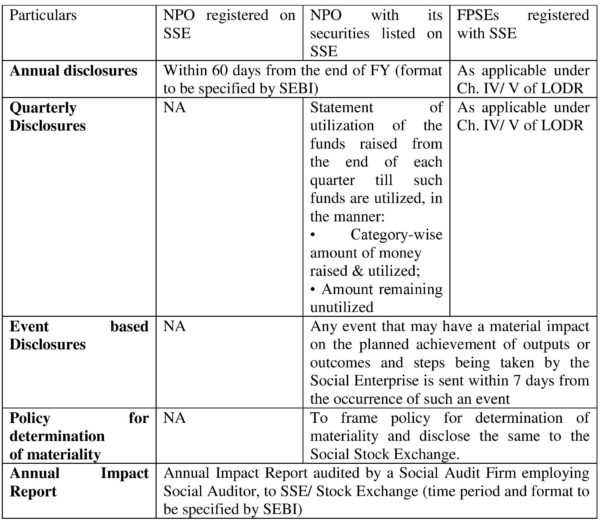
SEBI requires that every NPOs has to publish an annual impact report every year, detailing the impact of their work, and they also have to publish a statement of utilization of funds periodically. The AIR has to be audited by a social impact assessor like CA, CS and cost accountants could act as social impact assessors upon attaining certain certifications and meeting eligibility requirements.
Social Enterprises
1) Disclose any event that may materially impact their planned achievement of outputs or outcomes to the Social Stock Exchange(s) or Stock Exchange(s) where it has registered its specified securities within 7 days or specified time by the board from the occurrence of such events.
2) Submit an Annual Impact Report (AIR) capturing the qualitative and quantitative aspects of the social impact generated by the entity including the impact generated by the project or solution for which funds generated and audited by social auditor.
3) In case of NPO which is registered but not listing in SSE the AIR must cover the significant activities, programs, projects during the year and methodology for determining significance is to be explained.
4) AIR is required to be furnished within 90 days from the end of the financial year.
Minimum Aspects to be covered in AIR
The AIR should cover the aspects as described below:
- Strategic Intent and Planning
- Is there any social or environmental challenge facing the organization? Has this changed in the last year?
The problem statement is to be explained in detail. All challenges, causes, consequences, and parts of the problem shall be explained.
- How is the organization attending to the challenge or planning to attend to the challenge? Has this changed in the last year?
Explain the approach of the organization or the specific instrument it will be using or is already using. All changes have to be explained for the targeted beneficiary.
- Who is being impacted (target segment)? Has this changed in the last year?
The target beneficiaries / stakeholders cover various kinds of target groups. There should be a definition of target segments with dimensions as well.
- Income (driven by socio-demographic and/or behavioral characteristics)
- Geography, ecosystem, or geographic characteristics driven by population density (urban/rural), administrative boundaries, terrain, etc); and
- Thematic issue (gender, caste, community)
- Are there any outcomes from the activities, interventions, programs or projects? Disclosure should include positive and potential unintended negative outcomes.
Describe the Theory of change / logic model framework (defining input, output(s), outcome (s)) for the solution proposed. While identifying the targeted impact segment, both positive and potential unintended negative impacts need to be identified.
2. Approach
- What is the meaning of baseline status / situation analysis, / context description at the beginning of the activity/intervention/programs or project and at the end of the last reporting period?
The baseline measurement is done to establish the beginning point in any activity, intervention, program or project. The measurements give the depth of the challenge and/or the spread of the challenge. The organization will establish the right kind of measurements, keeping in mind what the organization or instrument wants to achieve since the baseline will be used to measure what actually changed due to the intervention. In the absence of a baseline study, a detailed situation analysis to be mentioned.
- What has been the past performance trend?
There should be intervention, program or project explain the key past performance trends and for the on-going activity or proposed activity, intervention, program or project explain the experience of similar programs in similar situations by the narrative.
- What are the solution implementation plan and the measures taken for sustainability of activity/intervention/programs or project outcomes? Is there any material change in your implementation model in the last year?
Detailed implementation plan where capturing all the essential activities. This interventions can be perennial support or time bound support as well as. In case of time bound support, the organization shall explain the exit strategy and how it ensures that the outcomes achieved will be sustained. The organization can explain how it ensures sustainability of the project/program in case of perennial support. Also, bring out possible deviations that might have occurred in the reporting period.
- Please brief out alignment of solution to Sustainable Development Goals (SDGs)/ national priorities/state priorities/ developmental priorities.
We need to explain the alignment of activity, intervention, program or project to respective SDGs and national/state priorities and schemes.
- How have you taken into consideration stakeholder feedback in this reporting period?
The organization to mention how they have mapped and prioritized the key stakeholders for the engagement. In reporting there should be include feedback, include the list of stakeholders and how the organisation used this feedback.
What biggest risk have you faced in the last year to achievement of desired impact? How are these being mitigated?
Explain the key potential risks concern to the organization or there should be specific instruments that can hinder the achievements of desired outcomes in the last year and must explain steps or strategies taken by organization to mitigate the problem.
3.Impact Score Card
- What are the metrices monitored and what has been the trend?
The organization shall be explained trend in performance through the trend of the data across the output, outcome and impact metrices. The metrices will catch the reach of the activity, intervention, program or project as well as the level of inclusiveness of impact being generated (direct, indirect, and extended). The metrices must check the target to cover the reach, depth and inclusion.
Reach: Proportion of target segment who accept the organization solution and reached in the reporting period, planned activity, programme, and project that have been achieved in the reporting period.
Depth: The depth of impact on the median individual Surveys
Inclusion: Net increase in Income levels of customers, Diversity and Inclusion and Social Equity
- Explain the narrative impact on the target segment in the reporting period.
There should be highlights, achievements, challenges and disappointments faced by organization during the reporting period.
- Beneficiary/Stakeholder Validation through surveys and other feedback mechanisms.
It is very important to see the perspective of stakeholders for the programme to draw a holistic picture of change that can be achieved by the programme the stakeholder voices would also help in capturing information that will help validate the impact claims. Which is checked and must avoid over claiming.
- What would have happened in the absence of this activity, intervention, program or project?
- How much the activity, intervention, program or project contributed to the changes that are evidenced?
- What can negative impact because of activity intervention, program or projects so explain it?
Disclosure Requirement for Social Enterprises
DISCLAIMER: The information provided in this article is intended for general informational purposes only and is based on the latest guidelines and regulations. While we strive to ensure the accuracy and completeness of the information, it may not reflect the most current legal or regulatory changes. Taxpayers are advised to consult with a qualified tax professional or you may contact to our tax advisor team through call +91-9871990888 or info@semantictaxgen.in.