
GST IMPLICATIONS ON THE EDUCATION SECTOR
Our country has always been an epicenter of knowledge since ancient times. Scholars from all over the country as well as the world have come to India to gain and obtain knowledge. The education culture, as written in ancient texts, give us an idea how the knowledge was imparted to the scholar in the ancient times where the students would live permanently with the teacher until the teacher was sure that they had gained knowledge to serve and live their life as educated persons.
Apart from that our country has witnessed great minds ever from the fields of mathematics to astronomy and from Aryabhatta to Ramanajun. This also shows a great dedication towards education in our country from the ancient times.
Thus, it becomes important that we have a proper explanation of the taxation implications and more particularly indirect taxation on the education sector.
In India, education is provided both by public as well as private sectors .Now-a-days education is run by organized industry with huge revenues.
The educational institutions that have been granted the exemption from GST are pre-schools and higher secondary educational institutes and they can either be private or government.
To clarify the applicability of GST on Educational Sector, we have to differentiate between core and non-core education activities since core educational services is exempted from GST and other education services are subject to GST @18%.
INTRODUCTION
At first, let us know what education is. “Education” is not defined in the CGST Act but as per Apex Court decision in Loka Shikshana Trust vs CIT, Mysuru, education is process of training and developing knowledge, skill and character of students by normal schooling.
If we discuss about educational institution, it is mentioned in the 2(y) of the notification 12/2017 which says:
√Pre-school education and education up to higher secondary school or equivalent;
√Education as a part of a curriculum for obtaining a qualification recognized by any law for the time being in force;

√Education as a part of an approved vocational education course.
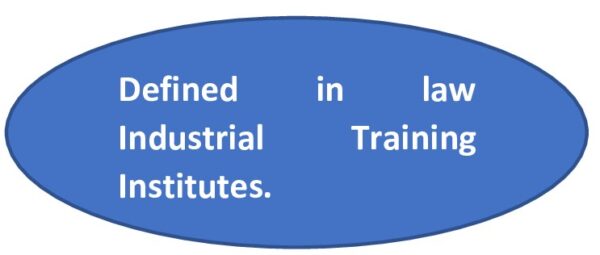
Above b) states, Education as a part of a curriculum for obtaining a qualification recognized by any law for the time being in force is also covered under the definition of educational institution. Let’s understand about Education as a part of curriculum for obtaining a qualification recognized by law:
Educational services as ‘a part’ of the curriculum that has been prescribed for obtaining a qualification prescribed by law and conduct of degree courses by colleges, universities or institutions which lead grant of qualifications recognized by law would be covered in negative class. Training given by private coaching institutes would not be covered as such training does not lead to grant of a recognized qualification.
Above c) says the education as a part of an approved vocational education courses is covered under the term educational institutions. Let’s understand what an approved vocational education course is:
(i) A course run by an industrial training institute or an industrial training centre affiliated to the National Council for Vocational Training or State Council for Vocational Training offering courses in designated trades notified under the Apprentices Act, 1961 (52 of 1961); or
(ii) A Modular Employable Skill Course, approved by the National Council of Vocational Training, run by a person registered with the Directorate General of Training, Ministry of Skill Development and Entrepreneurship.
Education Services are classified in heading 9992 and are further sub-divided into six groups comprising of:
- Pre-primary education services
- Primary education services
- Secondary Education Services
- Higher education services
- Specialized education services
- Other education & training services and educational support services
Place of Supply for Educational Services
GST must be collected and remitted by the supplier of services. While levying GST, the supplier must make a distinction between inter-state and intra-state supply to levy IGST or CGST and SGST. For educational services, the place of supply can be determined as follows:
If supply is made to a person having GST registration, the place of supply would be the location of such person.
If supply is made to a person other than a registered person, then place of supply would be where the event is held.
Registration of Educational Institutions
Educational Institute is providing only education as a service, then fees charged by the educational institute would attract nil rate. In that case that educational institute is not required to be registered.
Educational Institute is providing not only education, but also providing other services i.e providing books & uniforms to students, then that educational institute is liable to be registered.
Composite and Mixed Supply
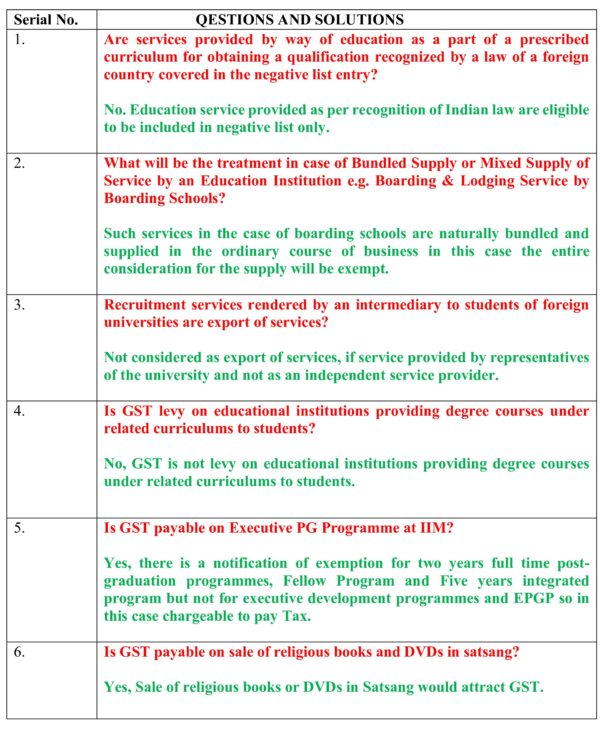
If utilities for education, lodging and boarding provided by the boarding schools are combined into a single structure, it is exempted from GST. If the value of education or lodging or boarding are attached then these services are bundled, and their taxability will be determined in terms of the principles laid down.
In case the fee structure is distinct for education, lodging and boarding, then such services would be evaluated separately. Since the predominant factor of education is determined by its service, the idea of providing residence will not be considered taxable.
EXEMPTED AND NON-EXEMPTED SERVICES
Services provided by an educational institution to students, faculty and staff
- The education provided by the private school from preschool to higher secondary is exempted under GST.
- Transportation of students, faculty and staff;
- Catering, including any mid-day meals scheme sponsored by the Central Government, State Government or Union territory;
- Security or cleaning or house-keeping services performed in such educational institution;
- Services relating to admission to, or conduct of examination by, such institution up to higher secondary:
- Entrance exam fee is exempted from the GST from education is wholly exempt from GST if a charitable trust is running a school, college or education institution for abandoned, orphans, homeless children, physically or mentally abused persons, prisoners or persons over the age of 65 years or above residing in a rural area.
- Government or local authority or governmental authority carrying on the activity of education is exempted from GST as this is not included in the ambit of supply of services. For Example – Government schools / Municipal schools.
- GST is not leviable on foods and drinks that are supplied by schools (up to higher secondary) directly to their students.
- National skill development corporation set up by the Indian government
- National skill development corporation approved sector skill councils
- National Skill Development Corporation approved assessment agencies.
- The national skill development programs approved by NSDC
- Vocational skill development program approved under national skill certification and monetary reward scheme
- Any scheme implemented by NSDC with training partners
- Exemption has also been granted to the services provided by the IIM–
- 2 year full-time residential PG programs in Management, admission in which is granted via CAT;
- Fellowship programs in Management;
- 5 Year Integrated Programs in management studies (but excludes the Executive Development Program).
Education Related Services:
- Curriculum related or course materials,
- Assessment and examination fees,
- Student administrative services such as registration, printing of academic transcripts, issuing or replacement of student cards, late fee payments, administration of the library etc.
- Excursion and field trips related to the course of study or part of curriculum requirement, except for food and accommodation supplied on those trips
GST Applicability to School-provided Food and Drinks
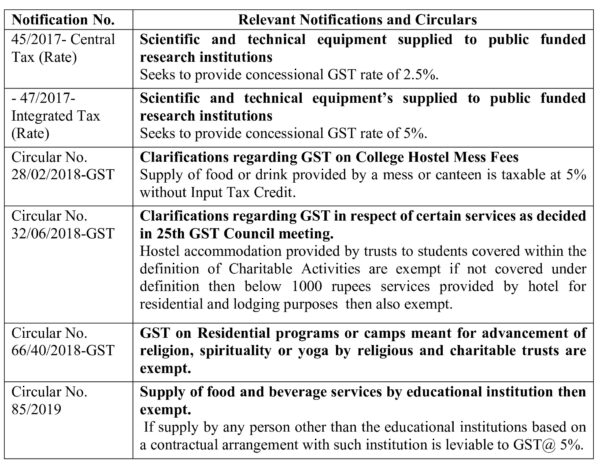
Food items supplied by school canteens and mess are taxable at 5 % GST rate with no input tax credit.
Applicability of GST in different scenarios in education sector
Coaching institutes are playing a very important role in today’s competitive world for the students preparing for government exams, IITs, banking, and other professional courses. Most of the students are enrolling in the coaching institutes and want to crack the competitive exams. Education by Coaching Institutes attracts 18% GST.
The exemption has also been granted to the services provided by the IIM:
- 2 year full-time residential PG programs in Management for Post Graduate Diploma in Management, admission in which is granted via CAT
- Fellowship programs in Management
- 5 Year Integrated Programs in management studies (but excludes the Executive Development Program)
Applicability of GST on Higher Educational Institutions:
The GST exemption on procurements is available only to schools (from pre-school up to higher secondary school or its equivalent).
But the ‘input’ or supply of services such as transportation, catering, housekeeping, services relating to admission or conduct of examination to higher educational institutions will bear GST levy. This will have to be borne by the higher educational institution.
Applicability of GST on Training programs, camps, yoga programs and other events:
Training programs, camps, yoga programs and other events is considered a commercial activity, liable for GST.
Applicability of GST on Hostel Services:
Hostel services that benefit female students and wage earners who are not liable to pay GST as they are accommodation facilities for female students and wage earners.
It must be noted that hostel mess services provided by education institutions can be in two situations:
- Charges of food is directly taken by the education institutions- An educational institution running a mess by its own is exempted from the levying of GST since it is in the nature of Composite Supply.
- Charges of food is directly taken by 3rd party which is appointed by the education institutions- Mess fees collected by the educational institutions and mess being run by a 3rd party is liable to GST @5% without eligibility for ITC.
Hostel accommodation services provided by Trusts to students covered within the definition of Charitable Activities and thus is exempt under. Hostel accommodation services do not fall within the ambit of charitable activities. However, services by a hotel, inn, guest house, club or campsite, by whatever name called, for residential or lodging purposes, having declared tariff of a unit of accommodation below Rs. 1000 per day or equivalent are exempt.
Whether books or stationery distributed to students covered under GST?
Uniform, stationery, and other non-academic related supplies are taxable under GST. Supplies provided by third parties like the musical instrument, computers, sports equipment and after-school activities offered directly by third parties are also taxable.
Supply of books is exempt under GST.
Chargeability of GST on Private Coaching centres and Distance Education
- Private institution and coaching centres do not have any specific curriculum and do not conduct any examination or award any qualification. Hence taxable at the rate of 18 %
- Distance Education is taken up generally for higher education and hence taxable at the rate of 18 % GST.
Following are not exempt from GST:
- Supplies provided by third parties like the musical instrument, computers, sports equipment,
- After school activities offered directly by third parties,
- Food and accommodation supplied for the excursion as described above,
- Uniform, stationery, and other non-academic related supplies
- If the school runs summer camp or coaching classes for other students apart from the school students.
- If the school rents the school premise for marriage and other functions.
- If the doctor or hospital makes earning more than Rs. 20 lakh by selling unused and other instruments.
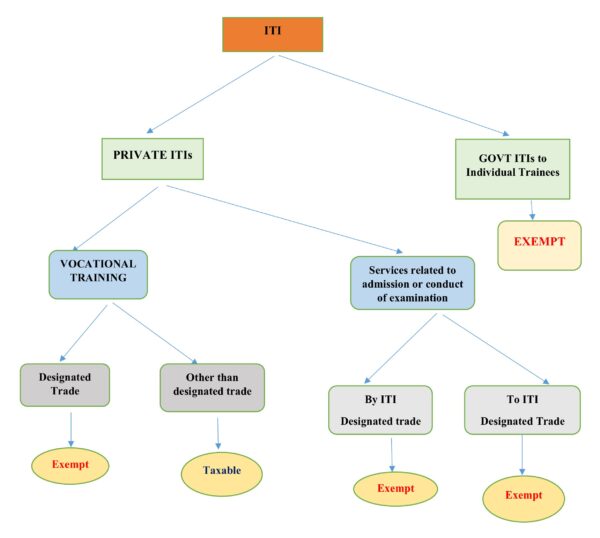
TAXABILITY OF SERVICES PROVIDED BY INDUSTRIAL TRAINING INSTITUTES:
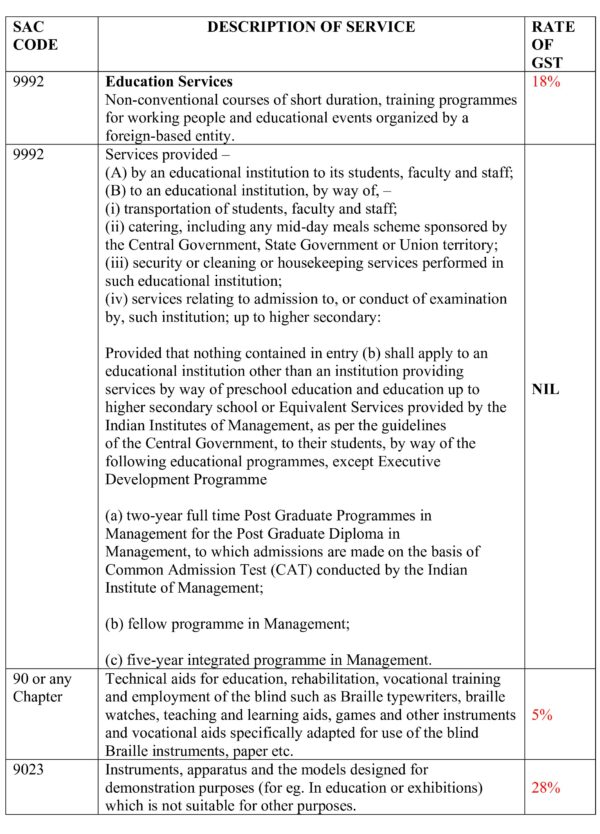
The SAC code and GST rate for educational services are as below:
FAQs
DISCLAIMER: The information provided in this article is intended for general informational purposes only and is based on the latest guidelines and regulations. While we strive to ensure the accuracy and completeness of the information, it may not reflect the most current legal or regulatory changes. Taxpayers are advised to consult with a qualified tax professional or you may contact to our tax advisor team through call +91-9871990888 or info@semantictaxgen.in.